Radial Drilling Machines and Workshop Tool Grinders: Industrial Applications, Types and Buying Guide
Every productive manufacturing workshop depends on a core set of machines that handle the most fundamental metal removal and finishing tasks. Drilling, boring, chamfering, notching, and tool grinding are operations that occur on virtually every production floor every single day, and the machines that perform them are among the most important investments a workshop will make. In this category, the radial drilling machine stands out as one of the most versatile and widely used machine tools in Indian industry, supported by an equally important range of tool grinders, notchers, and chamfering machines that keep both workpieces and cutting tools in productive condition.
This article covers the full range of drilling, grinding, notching, and chamfering machines relevant to modern Indian manufacturing workshops, their industrial applications across key sectors, and the factors that should guide your purchasing decisions.
Radial Drilling Machines: Versatility and Reach for Heavy Drilling Work
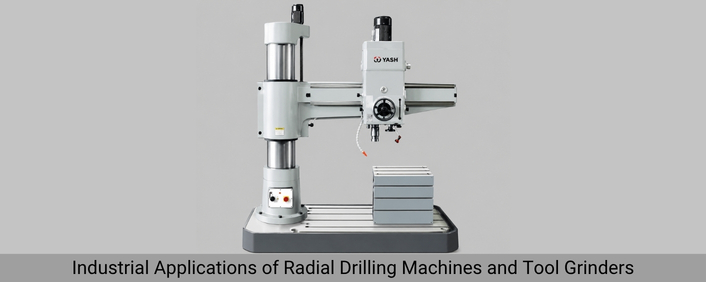
The radial drilling machine is the dominant drilling machine configuration in Indian heavy engineering, fabrication, and general manufacturing. Unlike a pillar drilling machine where the workpiece must be repositioned under a fixed spindle, a radial drilling machine features an arm that swings around a vertical column, with a spindle head that travels along the arm. This arrangement allows the operator to position the spindle over virtually any point on a large workpiece without moving the workpiece itself, which is a critical advantage when dealing with heavy castings, large structural components, and bulky fabrications.
The productivity advantage of the radial drilling machine is most apparent on large, heavy workpieces that would be difficult, time-consuming, or impossible to reposition repeatedly under a fixed spindle. A single setup on a radial drilling machine can cover dozens of hole positions across a large component, making it far more efficient than any fixed-spindle alternative for this class of work.
Radial drilling machines are used across an enormous range of industries in India. In heavy engineering, they drill and bore large flanges, pump casings, gearbox housings, and structural steel assemblies. In shipbuilding, radial drilling machines are essential for drilling bolt patterns and pipe penetrations in large hull sections and deck plates. In power generation, they machine turbine and generator components that are too large and heavy to handle on a conventional drilling machine. In railway workshops, they drill bogie frames, axle boxes, and large mechanical assemblies that require multiple accurately positioned holes.
The all geared radial drilling machine is the preferred variant for production and heavy-duty applications. An all geared radial drilling machine transmits power from the motor to the spindle entirely through an enclosed gear train, providing a wider range of spindle speeds and feed rates than belt-driven alternatives, with better power transmission efficiency and lower maintenance requirements. The all geared radial drilling machine delivers full torque at low speeds, which is essential when drilling large-diameter holes in tough materials such as stainless steel, alloy steel, and thick cast iron.
All geared radial drilling machines are available in a range of arm lengths and column heights to suit different workpiece sizes. Shorter arm models are appropriate for general workshop use and moderate component sizes. Longer arm models extend the reach of the spindle to cover very large workpieces, making them the standard choice in heavy fabrication shops, boiler manufacturers, and pressure vessel producers.
The radial drill machine is the same category described by different terminology, and it is equally common in Indian industry. Whether referred to as a radial drill machine or a radial drilling machine, the fundamental capability is identical: a swinging arm with a traversable spindle head that gives the operator maximum flexibility in positioning the drill over any point on the workpiece.
All geared radial drilling machines, all geared radial drills, and all geared radial drilling are all terms that refer to the same class of machine, and they represent the most capable and durable configuration available for production drilling in Indian manufacturing workshops.
Applications Across Key Industries
To understand the full value of the radial drilling machine, it helps to look at its role across specific industries in detail.
In the automotive industry, radial drilling machines are used to drill engine blocks, cylinder heads, transmission housings, and suspension components. While CNC machining centres handle the highest-precision work in large automotive plants, radial drilling machines remain essential in small to medium automotive component suppliers and in workshops that produce custom or low-volume automotive parts.
In the oil and gas industry, radial drilling machines drill and bore flanges, valve bodies, pump housings, and pressure vessel components. The heavy materials and large component sizes common in this sector make the all geared radial drilling machine the natural choice for both production work and maintenance operations.
In the defence sector, radial drilling machines produce components for armoured vehicles, artillery systems, naval vessels, and support equipment. The combination of versatility, heavy-duty capability, and the ability to work on large components makes the radial drilling machine indispensable in defence manufacturing and maintenance workshops.
In general fabrication and structural steel work, radial drilling machines drill bolt patterns, connection plates, and gussets in the fabricated steel structures used in buildings, bridges, industrial plants, and infrastructure projects. The ability to swing the arm over a large flat workpiece and drill multiple holes in a single setup makes the radial drilling machine far more productive than a pillar drill for this class of work.
Our Other Product
Tool Room MachinesDrill Bit Grinders: Keeping Your Drilling Tools Sharp and Productive
The productivity of any drilling operation depends directly on the condition of the drill bits being used. A sharp, correctly ground drill bit cuts cleanly, generates less heat, and produces accurately sized holes. A worn or incorrectly ground drill bit requires more force, generates excessive heat, produces oversized or out-of-round holes, and wears out quickly. The drill bit grinder is the machine that keeps your drilling tools in peak condition.
A drill bit grinder restores worn drill bits by re-grinding the cutting edges to the correct geometry, including the point angle, lip relief angle, and chisel edge condition. A properly sharpened drill bit from a quality drill bit grinder will perform as well as a new drill bit, at a fraction of the cost. For workshops that use large quantities of drill bits across their radial drilling machines and other drilling equipment, the drill bit grinder delivers significant savings in tooling costs over time.
The drill point grinder is a more specialised variant that focuses specifically on the tip geometry of the drill, grinding the point to precise angles and producing a well-formed chisel edge that improves hole accuracy and reduces the thrust force required to start the cut. A drill point grinder is particularly valuable in workshops that drill difficult materials or require consistently accurate hole sizes, such as in the automotive, aerospace, and precision engineering sectors.
Tool Grinders: Maintaining the Full Range of Workshop Cutting Tools
Beyond drill bits, any workshop that runs milling machines, lathes, and boring machines accumulates a range of cutting tools that require periodic re-sharpening to maintain their performance. The tool grinder is the machine that handles this broader range of tool maintenance work.
A tool grinder is used to sharpen and re-profile single-point turning tools, milling cutters, reamers, taps, and other cutting tools used across the workshop. By restoring cutting tools to their correct geometry, a tool grinder extends tool life, improves surface finish on machined components, and reduces the frequency of tool replacement. Workshops that invest in a quality tool grinder and train their operators to use it effectively typically see significant reductions in tooling costs and improvements in machining quality.
The end mill grinder is a specialised tool grinder designed specifically for re-sharpening end mills used in vertical milling machines and CNC milling machines. End mills are among the most expensive cutting tools in a workshop’s inventory, and a quality end mill grinder allows worn end mills to be restored to serviceable condition multiple times before they are no longer usable. The savings from systematic use of an end mill grinder in a workshop that runs multiple milling machines can be very substantial.
The complex grinder handles the most demanding tool grinding work, including the re-grinding of form tools, gear cutters, and specialised cutting tools with complex geometries that require precise multi-axis grinding capability. Complex grinders are found in toolrooms, cutting tool manufacturers, and advanced precision engineering workshops where the ability to produce and maintain complex cutting tool geometries in-house is a competitive advantage.
The screw tap grinder and screw blade grinder are further specialised grinding machines for maintaining taps used in threading operations and blades used in cutting and slitting machines respectively. These specialised grinders are found in workshops that use large quantities of taps and cutting blades and where the cost of replacement tooling makes in-house resharpening economically attractive.
Chamfer Machines and Chamfering Machines: Clean Edges for Better Components
Chamfering is the process of cutting a bevelled edge at the end or on the face of a workpiece, and it serves both functional and aesthetic purposes. Functionally, a chamfer removes the sharp burr left by drilling, turning, or milling, making components safer to handle and easier to assemble. It also provides a lead-in for threaded fasteners, improves the strength of welded joints by creating a weld preparation, and reduces stress concentrations at sharp corners.
The chamfer machine is a dedicated machine for producing consistent chamfers on the ends and faces of workpieces quickly and accurately. Chamfer machines are used extensively in the automotive industry for deburring and chamfering shaft ends, gear blanks, and bearing seats. In the fastener industry, chamfer machines prepare the ends of bolts, studs, and pins before threading. In the pipe and tube industry, they prepare pipe ends for welding by cutting precise weld preparation chamfers. In general engineering, chamfer machines deburr and finish components across virtually every production process.
The chamfering machine covers the same category with the same range of applications. Whether referred to as a chamfer machine or a chamfering machine, the purpose is identical: producing clean, consistent bevelled edges that improve component quality, safety, and assembly efficiency.
Investing in a dedicated chamfer machine rather than performing chamfering by hand or on a lathe saves significant production time in any workshop that regularly needs to deburr and chamfer large quantities of components. The consistency of a chamfer machine also produces better results than manual chamfering, particularly on components where the chamfer angle and depth must be controlled to meet assembly or weld preparation specifications.
Read Our Article
Choosing the Right Drill BitNotchers and Pipe Notchers: Precision Joints for Tubular Fabrication
For workshops that fabricate frames, structures, and pipework from tubes and hollow sections, the notcher is an essential tool. A notcher cuts a shaped profile at the end of a tube or hollow section that allows it to fit precisely against another tube at a specific angle, creating a tight joint that can be welded without gaps or misalignment.
The tube notcher is the most common variant, designed to cut circular notches at the ends of round tubes for butt or saddle joints. Tube notchers are widely used in the manufacture of structural frames, motorcycle and bicycle frames, roll cages, furniture frames, handrails, and sports equipment. The precision fit produced by a tube notcher dramatically reduces the time required for joint fitting and produces stronger, cleaner welds than joints fitted by hand.
The precision pipe notcher extends this capability to larger pipe sizes and to applications where the notch geometry must be controlled to tighter tolerances, such as in pressure piping, heat exchanger fabrication, and industrial pipework. A precision pipe notcher produces consistently accurate notch profiles that ensure tight joint fit-up across the full range of pipe sizes it handles.
For workshops that fabricate structural sections and frames from flat bar, angle, and hollow section, the notcher in its broader form cuts square or rectangular notches in material ends, allowing clean corner joints to be made in box sections and frames. This type of notching is common in the fabrication of machine guarding, conveyor frames, steel furniture, and industrial shelving.
What to Look for When Buying Drilling and Grinding Equipment
Selecting the right radial drilling machine, tool grinder, chamfer machine, or notcher for your workshop requires a clear understanding of your production requirements and the quality standards you need to meet.
For radial drilling machines, the key specifications are arm length, maximum drilling capacity in steel, spindle speed range, and feed rate range. Choose an arm length that comfortably covers the largest workpiece you regularly handle. Ensure the spindle speed range covers both the slow speeds needed for large-diameter holes in tough materials and the higher speeds needed for small-diameter holes in softer materials. An all geared radial drilling machine will serve you better than a belt-driven alternative in any production environment, because the gear drive delivers more consistent power across the full speed range and requires less maintenance.
For tool grinders and drill bit grinders, the quality of the grinding spindle bearings and the precision of the grinding wheel dresser are the most important factors. A tool grinder with a high-quality spindle and a precise dresser will produce accurately ground tools consistently, while a machine with poor spindle quality will produce inconsistent results regardless of the operator’s skill.
For chamfer machines and notchers, the quality of the tooling and the rigidity of the machine structure determine the consistency and finish quality of the work. Invest in a machine that uses quality tooling and has a robust enough structure to hold the workpiece firmly during the cut, and you will produce consistently clean, accurate chamfers and notches across the full range of components your workshop handles.
Conclusion
The radial drilling machine, in all its configurations from the standard radial drill machine to the all geared radial drilling machine with extended arm reach, remains one of the most productive and versatile machine tools in Indian manufacturing. Supported by drill bit grinders, tool grinders, end mill grinders, chamfer machines, and notchers that keep both workpieces and cutting tools in peak condition, this family of machines forms an essential foundation for any serious engineering workshop. India’s continued growth in heavy engineering, automotive, defence, infrastructure, and fabrication creates sustained demand for capable, well-maintained drilling and tool grinding equipment. Workshops that invest in quality radial drilling machines and supporting equipment today will be well positioned to meet the growing demands of Indian manufacturing for years to come.
FAQs
Which Machine Should You Prioritize First?
The right starting point depends on the type of work your workshop handles. If large components require frequent drilling at multiple locations, a radial drilling machine should be the priority. Workshops with high drill-bit consumption can benefit from adding a drill bit grinder to reduce tooling costs. If the workshop also performs milling and turning operations, a general-purpose tool grinder provides broader tooling maintenance capability.
When Is an All Geared Radial Drilling Machine Worth the Investment?
An all geared radial drilling machine becomes particularly valuable when drilling large-diameter holes, working with tough materials, or operating the machine for extended production hours. The geared transmission provides consistent spindle power and a broad speed range, making it better suited to demanding production environments than simpler belt-driven configurations.
Should Tool Grinding Be Done In-House?
For workshops that consume a significant number of drill bits, end mills, taps, or other cutting tools, in-house grinding can reduce replacement costs and minimise production interruptions. However, the benefit depends on tooling consumption, operator skill, and the type of tools being maintained. High-volume workshops generally have a stronger economic case for dedicated grinding equipment.
How Do Chamfering and Notching Affect Fabrication Productivity?
Chamfering and notching are often treated as secondary operations, but they can have a significant impact on overall production time. Dedicated chamfering machines can standardise edge preparation and reduce manual deburring, while tube notchers can significantly shorten the fitting time required before welding tubular structures. In repetitive fabrication work, these time savings can accumulate quickly.
What Should Be Evaluated Beyond Machine Specifications?
A machine should not be selected solely on drilling capacity, spindle speed, or motor power. Buyers should also evaluate machine rigidity, component quality, ease of maintenance, tooling availability, operator convenience, spare-parts support, installation assistance, and after-sales service. These factors can have a greater effect on long-term productivity than a small difference in the initial purchase price.
When Does a Workshop Need More Than One Machine?
A workshop handling diverse fabrication and machining work may benefit from a combination of machines rather than relying on one multifunctional unit. For example, a radial drilling machine can handle heavy drilling, a drill bit grinder can maintain frequently used drills, a tool grinder can service broader cutting-tool requirements, and a chamfer machine or tube notcher can streamline downstream fabrication operations.
How Can Machine Selection Be Matched to Production Volume?
Low-volume workshops generally benefit from versatile machines that can accommodate different jobs with minimal setup.
Medium-volume workshops can justify dedicated machines for frequently repeated operations, improving consistency and reducing setup time.
High-volume production facilities should prioritise specialised or automated equipment where cycle time, repeatability, and tooling efficiency have a direct impact on production costs.
What Is the Most Common Buying Mistake?
One of the most common mistakes is selecting a machine based only on the maximum advertised capacity. A workshop should instead evaluate the capacity required for its regular production workload, including material type, workpiece dimensions, hole sizes, operating hours, and expected future requirements. Selecting equipment with adequate working capacity and some practical operating margin is generally more useful than simply choosing the largest available model.

Mr. Yash Shah brings extensive knowledge of workshop machinery and precision engineering to his writing, drawing on years of hands-on exposure to the machine tools industry. He writes on a broad spectrum of equipment, including Lathe Machines, Radial Drilling Machines, Milling Machines, CNC Machines, Grinding Machines, Boring Machines, Planing Machines, and other workshop machinery essential to modern manufacturing. His articles focus on practical applications, machine selection, and the role these tools play in improving shop-floor efficiency and production quality. Mr. Shah is associated with Yash Machine Tools, a trusted name in the manufacturing and supply of workshop machinery, known for delivering reliable, industry-grade solutions to clients across India and abroad.
Summarize with AI:




Listen Article:
- Planing Machines and CNC Cutting Machines: Types, Features and Industrial Applications
- Welding Machines: Types, Applications and How to Choose the Right Welder for Your Workshop
- Types of Workshop Machinery: Milling, Grinding, Bandsaw and Tool Room Machines Explained
- Sheet Metal Machines: Types, Applications and How to Choose the Right One
- Drill Machine: Types of Drilling Machines and Their Industrial Applications
- Milling Machines in Modern Industry: Applications, Types and How to Choose the Right One for Your Workshop