


Milling Machines in Modern Industry: Applications, Types and How to Choose the Right One for Your Workshop
Across India’s manufacturing landscape, the milling machine has earned its place as one of the most versatile and productive machine tools on any workshop floor. Where a lathe machine rotates the workpiece, a milling machine rotates the cutting tool against a stationary or linearly moving workpiece, enabling the production of flat surfaces, slots, keyways, gear teeth, pockets, and complex three-dimensional profiles that no other single machine tool can replicate as efficiently.
From aerospace and automotive component manufacturing to defence fabrication, die and mould making, and general engineering, the milling machine serves a remarkable breadth of industrial applications. As Indian manufacturers scale up their capabilities to compete both domestically and in export markets, understanding the different types of milling machines and their specific applications has never been more important.
This article covers the major types of milling machines available today, the industries that depend on them, and the key factors that should guide your purchase decision.
Why Milling Machines Are Central to Precision Manufacturing
The ability to machine flat faces, contoured profiles, slots, and complex geometries in a single setup is what makes milling machines indispensable. Unlike turning operations that are limited to rotationally symmetric components, milling can be applied to prismatic parts of almost any shape, which is why the milling machine is found in virtually every sector that produces engineered components.
Modern milling machines range from compact benchtop units for toolroom and prototype work to large floor-standing machines used in heavy fabrication. At the top of the capability ladder sit CNC milling machines and vertical machining centres that execute complex multi-axis cutting programs automatically. Below them, a range of manually operated and semi-automated machines serve workshops where flexibility and operator skill matter more than automation.
Understanding where your production requirements sit on this spectrum is the starting point for choosing the right milling machine.
Vertical Milling Machines: The Workhorse of Indian Engineering Workshops
The vertical milling machine is the most widely used milling configuration in Indian industry, and for good reason. In a vertical milling machine, the spindle axis is oriented vertically, pointing downward toward the worktable. This arrangement makes it natural and intuitive to machine the top face of a workpiece, drill holes, mill slots, and produce flat surfaces, which are among the most common operations required in general engineering.
The vertical milling machine is found in automotive component workshops, pump and valve manufacturers, tool and die shops, defence sub-contractors, and general fabrication facilities across the country. Its straightforward setup, wide range of available tooling, and the ease with which operators can observe and control the cutting process make it the first choice for workshops that handle varied work.
Within the vertical milling machine category, the turret milling machine is a particularly popular variant. A turret milling machine features a stationary spindle and a table that moves both horizontally and vertically, giving the operator the flexibility to position the workpiece precisely relative to the cutter. Turret milling machines are especially valued in toolrooms and job shops because their compact footprint and operational flexibility allow a single operator to tackle a wide variety of jobs without extensive setup changes.
Turret milling is also widely used in the production of jigs, fixtures, and machine components, where the combination of precision and flexibility that a turret milling machine offers is difficult to match with any other configuration.
For workshops that need vertical milling capability in a more compact form, the mini milling machine provides a practical solution. A mini milling machine delivers the same fundamental milling capability as a full-size vertical machine but in a smaller, lighter package suited to benchtop or small floor installation. Mini milling machines are commonly used in training workshops, small tool rooms, prototype departments, and light production environments where floor space is limited and component sizes are modest.
Bed Type Milling Machines: Built for Production and Heavy Work
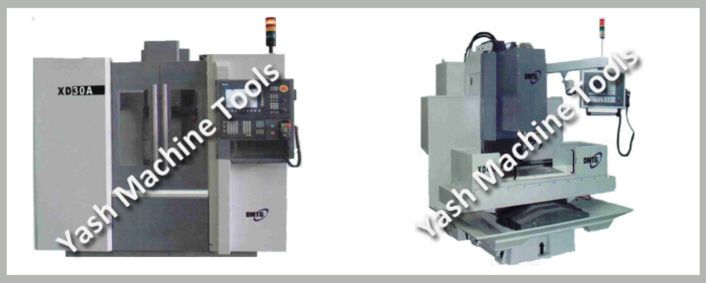
Where the turret milling machine excels at flexibility and varied work, the bed type milling machine is designed for production machining of larger components. In a bed type milling machine, the worktable moves only in the longitudinal direction, with the spindle head providing the transverse and vertical movement. This arrangement gives the bed type milling machine exceptional rigidity, making it better suited for heavy cuts on large workpieces.
Bed type milling machines are found in heavy engineering shops, structural component manufacturers, and production facilities where large flat surfaces, deep pockets, and long slots need to be machined accurately and consistently. The superior rigidity of the bed type milling machine compared to a knee-type machine translates into better surface finish, longer tool life, and more consistent results when the machine is working at the limits of its capacity.
For workshops that machine large castings, fabricated steel structures, or heavy mechanical assemblies, the bed type milling machine is often the most appropriate choice.
Universal Milling Machines: Flexibility Across a Wide Range of Operations
The universal milling machine adds a degree of versatility that neither the standard vertical milling machine nor the bed type machine can fully match. A universal milling machine is equipped with a swivelling table that can be angled relative to the spindle, enabling helical milling operations such as the cutting of helical gears, twist drill flutes, and spiral cams. This capability makes the universal milling machine indispensable in toolrooms and workshops that produce or repair gears, cutting tools, and complex mechanical assemblies.
Universal milling machines are used in defence manufacturing for producing gears and specialised components, in the automotive industry for gear and shaft production, and in precision engineering workshops that take on a wide variety of custom machining work. The combination of horizontal and vertical milling capability in a single machine also means the universal milling machine can handle operations that would otherwise require two separate setups on different machines.
For workshops that value flexibility above all else and need a single machine that can handle the broadest possible range of milling work, the universal milling machine is often the best investment.
Read Our Article
Tool Room MachinesHorizontal Milling Boring Machines: Tackling Large and Complex Workpieces
For large, heavy components that cannot easily be repositioned on a worktable, the horizontal milling boring machine offers a powerful solution. In a horizontal milling boring machine, a horizontal spindle carries facing heads, boring bars, and milling cutters to machine large bores, faces, and contoured profiles on heavy workpieces such as gearbox housings, engine blocks, large flanges, and structural steel assemblies.
Horizontal milling boring machines are found in heavy engineering, shipbuilding, power generation, and large-scale machinery manufacturing. Their ability to perform multiple operations including milling, boring, drilling, and facing in a single setup on large components makes them highly productive and cost effective in environments where component repositioning is difficult and time-consuming.
The milling cum drilling machine represents a more compact approach to combining milling and drilling in a single unit. A milling cum drilling machine is particularly useful in smaller workshops and training facilities where a full range of milling and drilling operations is needed but budget and floor space constraints make purchasing two separate machines impractical.
CNC Milling Machines and Vertical Machining Centres: Automation at Scale
For workshops that produce high volumes of precision components and need to minimise operator variability, the CNC milling machine and the vertical machining centre represent the pinnacle of milling technology available today.
A CNC milling machine executes pre-programmed cutting sequences under computer numerical control, producing complex geometries repeatably across large production runs with minimal operator intervention. CNC milling machines are used across the automotive, aerospace, defence, medical device, and electronics industries for producing components that must meet tight dimensional tolerances consistently.
The vertical CNC milling machine is the most common CNC milling configuration, combining the intuitive vertical orientation of a conventional vertical milling machine with full CNC control of all axes. A vertical CNC milling machine is well suited to prismatic components, die and mould cavities, and the production of detailed surface profiles that would be impossible to achieve manually.
For workshops that need even higher levels of automation and capability, the CNC milling and VMC (vertical machining centre) takes vertical CNC milling further by adding an automatic tool changer, a more rigid machine structure, and often a rotary fourth axis. Vertical machining centres are now increasingly common in Indian automotive and aerospace supply chains, driven by the growing demand for components that meet international quality standards.
The CNC trainer milling machine plays an important supporting role in this environment. As more Indian workshops invest in CNC milling and VMC technology, the need for trained CNC operators grows alongside it. CNC trainer milling machines used in engineering colleges, ITIs, and in-house training centres give students and new operators the hands-on experience with CNC controls and programming that prepares them for productive work on full-production CNC machines.
End Mill Grinders: Keeping Your Cutting Tools Sharp and Productive
No discussion of milling machines is complete without addressing the tooling that makes them work. End mills, the cutting tools used in vertical and CNC milling operations, are expensive consumables that wear with use. An end mill grinder restores worn end mills to serviceable condition, extending tool life significantly and reducing tooling costs.
An end mill grinder is a valuable addition to any workshop that runs vertical milling machines or CNC milling machines at significant volume. Rather than discarding worn cutters and purchasing new ones, an end mill grinder allows the workshop to re-sharpen and reuse end mills multiple times before they are no longer serviceable. Over the life of a milling operation, the savings from systematic use of an end mill grinder can be substantial.
 Request a Call Now!
Choosing the Right Milling Machine: Key Considerations
With such a wide range of milling machine types available, selecting the right one requires a clear understanding of your production requirements. Consider the following factors before making a decision.
The size and weight of your typical workpiece should guide your choice of machine size and configuration. A turret milling machine or mini milling machine is appropriate for smaller components. A bed type milling machine or horizontal milling boring machine is more appropriate for large, heavy parts.
The nature of the operations you need to perform matters equally. If your work is predominantly face milling, slotting, and drilling on prismatic components, a vertical milling machine will handle it efficiently. If you need to produce helical gears or complex toolroom work, a universal milling machine offers the additional flexibility required.
Production volume and consistency requirements determine whether a manual machine, a semi-CNC machine, or a full vertical CNC milling machine is the right investment. For low volumes and varied work, manual flexibility is valuable. For high volumes and tight tolerances, CNC automation delivers the consistency and productivity that manual machining cannot reliably provide.
Finally, consider the availability of tooling, spare parts, and service support for the machine you are evaluating. A well-supported milling machine from a reputable manufacturer will deliver better long-term value than a machine with lower upfront cost but poor after-sales support.
Conclusion
The milling machine in all its forms continues to be one of the most important investments an Indian manufacturing workshop can make. Whether you are setting up a small toolroom with a turret milling machine or mini milling machine, expanding a production floor with a bed type milling machine or universal milling machine, or investing in a vertical CNC milling machine or full VMC for high-volume precision work, the right milling machine will deliver returns in productivity, quality, and competitive capability for years to come.
As India’s manufacturing sector continues its growth trajectory, workshops that invest in the right milling technology today will be best positioned to take on the more demanding work that tomorrow’s industrial growth will bring.
- Types of Workshop Machinery: Milling, Grinding, Bandsaw and Tool Room Machines Explained
- Sheet Metal Machines: Types, Applications and How to Choose the Right One
- Drill Machine: Types of Drilling Machines and Their Industrial Applications
- How Lathe Machines Power India’s Manufacturing Sector: Applications Across Automotive, Defence and Heavy Engineering
- Radial Drilling Machines and Workshop Tool Grinders: Industrial Applications, Types and Buying Guide


