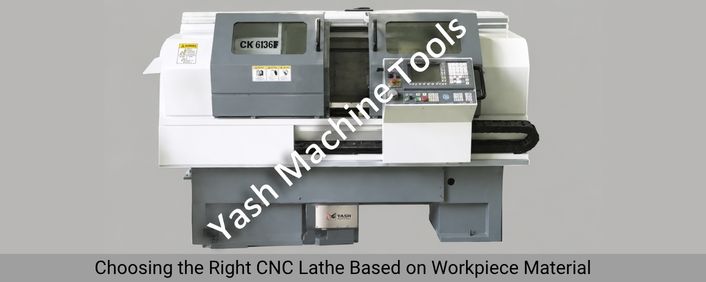
How to Choose the Right CNC Lathe Machine for Your Shop?
CNC Lathe Machine: Selecting the Right Machine for Your Requirements
Selecting a CNC lathe machine is one of the most impactful purchasing decisions a machine shop can make. The wrong choice leads to production bottlenecks, excessive scrap rates and poor return on capital. This guide walks you through the critical decision factors – production volume, workpiece material, axis configuration, control systems and budget – so you can match the right machine to your actual operational requirements.
CNC Lathe Machine Types: Flat Bed vs. Slant Bed – Which Suits Your Work?
The first structural decision is choosing between a flat bed CNC lathe machine and a slant bed CNC lathe machine. Each design suits different production environments.
A flat bed CNC lathe positions the carriage and cross-slide on a horizontal plane. This geometry makes the machine easier to set up for manual intervention, heavy workpiece loading and large-diameter turning. Shops that frequently handle oversized components, require wide swing capacity or operate in job-shop environments with frequent part changeovers often find a flat-bed CNC lathe to be the more practical choice.
A slant bed CNC lathe machine mounts the turret and saddle on an inclined bed, typically at 30°, 45° or 60°. This design improves chip evacuation, as cuttings fall away from the work zone by gravity rather than accumulating around the cutting tool. The inclined geometry also enhances rigidity during high-speed turning and tightens the distance between the spindle centerline and the guideway, which reduces vibration at elevated feeds and speeds. For high-volume precision turning, a slant bed CNC lathe consistently outperforms its flat bed counterpart on surface finish and dimensional repeatability.
If your shop runs long production runs on small-to-medium diameter shafts, bearing journals or hydraulic components, a slant bed CNC lathe machine is typically the more productive option. If your work involves intermittent heavy turning or large chuck work, a flat bed CNC lathe machine gives you the access and swing you need.
 Call Now!
Production Volume and Cycle Time Requirements Shape Your Machine Selection
Your daily or monthly part output directly influences which CNC lathe specification to prioritise. Low-to-medium volume job shops can get strong results from a general-purpose CNC lathe with a single turret, standard spindle speed range and a 6–8 station tool post. High-volume production environments demand live tooling, sub-spindle capability and driven tool capacity so that milling, drilling and tapping operations happen within a single setup cycle – eliminating secondary operations and cutting cost per part.
If your production volume is above 500 parts per shift, evaluate CNC lathes with bar feeder compatibility and automatic part transfer. Cycle time reduction at this scale depends on spindle acceleration, rapid traverse rates and turret indexing speed – not just cutting parameters. A slant bed CNC lathe machine with a 12-station turret, high-torque spindle motor and servo-driven tailstock will consistently deliver shorter cycle times than a basic flat bed configuration on repetitive turned components.
Workpiece Material Dictates Spindle Power, Rigidity and Coolant Strategy
Material machinability is a decisive factor when specifying a CNC lathe. Aluminium, brass and soft plastics require high spindle RPM and moderate torque. Stainless steel, titanium, Inconel and hardened tool steels demand high torque at lower speeds, robust guideway preload and high-pressure through-spindle coolant.
A flat bed CNC lathe machine with a large spindle bore and high-torque motor handles tough alloys well, particularly in heavy roughing applications where the machine’s mass dampens cutting forces. A slant bed CNC lathe machine with a rigid box guideway or linear roller guideway is better suited for finishing operations on difficult materials where surface finish below Ra 0.8 µm is required.
Always check the spindle motor’s continuous power rating – not just peak power – and confirm that the guideway type matches the cutting loads your material demands.
Axes Configuration and Live Tooling: Matching Capability to Part Complexity
A standard 2-axis CNC lathe covers facing, turning, boring, threading and grooving. If your parts require off-centre features, hexagonal profiles, cross-drilled holes or flat milling, you need a CNC lathe with a C-axis and live tooling. Adding a Y-axis extends that capability to eccentric features and off-centre milling.
For parts requiring complete machining in one setup – prismatic features, back-face operations or complex multi-surface geometries – a CNC lathe machine with sub-spindle and B-axis or Y-axis capability delivers the highest process integration. These multi-axis configurations increase upfront investment but substantially reduce work-in-progress inventory, part handling and fixturing costs.
Evaluate part drawings critically before specifying axis count. Over-specifying axes on simple turned components adds cost without productive return.
Our Other Product
All Geared Lathe MachineCNC Control Systems: Evaluating Programming Capability, Connectivity and Support
The control system is the operator interface between your programming environment and the machine tool. The most widely deployed control platforms on CNC lathes globally are Fanuc, Siemens, Mitsubishi and Haas. Each offers different levels of conversational programming, CAM post-processor compatibility, network connectivity and remote diagnostics capability.
For shops running ISO G-code programs from CAM software, Fanuc-compatible controls remain the most universally supported. Siemens controls offer advanced cycle programming, particularly suited to complex multi-axis and Swiss-type turning applications. When evaluating a CNC lathe, confirm that your existing CAM system has a verified post-processor for the target control and that the control supports Ethernet or Industry 4.0 connectivity if machine monitoring or ERP integration is a requirement.
Operator training cost is also a real factor. If your team already works on one control platform, standardising across your CNC lathe fleet reduces training overhead and programming error.
Budget Considerations: Total Cost of Ownership beyond the Purchase Price
Machine purchase price is only one component of the true cost of ownership. Factor in installation, foundations, tooling packages, workholding, coolant systems, preventive maintenance contracts and spare parts availability when comparing CNC lathe options.
Entry-level CNC lathes from Taiwanese or Indian manufacturers offer competitive specifications for light-to-medium production environments and carry significantly lower acquisition costs than equivalent Japanese or German machines. Premium builders – Mazak, DMG Mori, Okuma, Doosan – justify higher price points through longer service life, tighter thermal compensation, faster spindle ramp rates and stronger application engineering support.
For budget-conscious shops, a mid-range slant bed CNC lathe machine with a reputable control system, linear guideways and verified spare parts availability often delivers better long-term value than the cheapest option with limited service infrastructure. Always request a machine accuracy certification and verify spindle runout, positioning repeatability and guideway parallelism before acceptance.
Conclusion
Choosing the right CNC lathe machine requires an honest assessment of your production volume, part geometry, material range, required precision and total budget – not just specifications on a datasheet. Whether you select a flat bed CNC lathe machine for heavy general-purpose turning or a slant bed CNC lathe machine for precision high-volume production, aligning the machine’s structural design, axis configuration and control system with your actual shop requirements is what determines long-term productivity and profitability.
FAQs
What factors should be considered when choosing a CNC lathe machine?
Key factors include workpiece size and material, production volume, required accuracy, spindle power and speed, axis configuration, tooling requirements, CNC control system, available floor space, and total cost of ownership.
Which is better: a flat bed or slant bed CNC lathe machine?
How much spindle power does a CNC lathe need?
The required spindle power depends mainly on the workpiece material, diameter, cutting depth, and production requirements. Tough materials and heavy roughing operations generally require higher continuous spindle torque and power than aluminium or other easily machinable materials.
How many axes are required for a CNC lathe?
A standard 2-axis CNC lathe is sufficient for conventional turning, facing, boring, threading, and grooving. Parts requiring cross-drilling, milling, off-centre features, or machining on multiple surfaces may require C-axis, Y-axis, live tooling, or sub-spindle capabilities.
Which CNC control system should I choose for a CNC lathe?
The right control depends on your existing programming skills, CAM software, required machining functions, and service support. Fanuc, Siemens, Mitsubishi, and Haas are widely used options. Compatibility with your CAM post-processor and operator experience should be considered before selection.
What should be included when calculating the cost of a CNC lathe machine?
Consider more than the machine's purchase price. Include installation, tooling, workholding equipment, coolant systems, bar feeders, maintenance, spare parts, operator training, electricity consumption, and service support to determine the machine's actual total cost of ownership.
How can I determine the right CNC lathe size for my components?
Review the maximum component diameter, length, weight, and spindle bore required for your regular production jobs. Choose a machine that provides sufficient swing, distance between centres, chuck capacity, and spindle bore with some operating margin rather than selecting a machine based only on your average component size.

Mr. Yash Shah brings extensive knowledge of workshop machinery and precision engineering to his writing, drawing on years of hands-on exposure to the machine tools industry. He writes on a broad spectrum of equipment, including Lathe Machines, Radial Drilling Machines, Milling Machines, CNC Machines, Grinding Machines, Boring Machines, Planing Machines, and other workshop machinery essential to modern manufacturing. His articles focus on practical applications, machine selection, and the role these tools play in improving shop-floor efficiency and production quality. Mr. Shah is associated with Yash Machine Tools, a trusted name in the manufacturing and supply of workshop machinery, known for delivering reliable, industry-grade solutions to clients across India and abroad.
Summarize with AI:




Listen Article:
- Heavy-Duty Lathe vs. Medium-Duty Lathe: Which One Does Your Manufacturing Unit Need?
- Planing Machines and CNC Cutting Machines: Types, Features and Industrial Applications
- Welding Machines: Types, Applications and How to Choose the Right Welder for Your Workshop
- Types of Workshop Machinery: Milling, Grinding, Bandsaw and Tool Room Machines Explained
- Sheet Metal Machines: Types, Applications and How to Choose the Right One
- Drill Machine: Types of Drilling Machines and Their Industrial Applications