How CNC Press Brake Machines Are Used in HVAC, Automotive and Electrical Cabinet Manufacturing
Introduction: Why Industry-Specific Press Brake Knowledge Matters
The CNC press brake machine is one of the most versatile and productive tools in sheet metal fabrication. But versatility does not mean that all press brake applications are the same. The demands placed on a press brake machine in an HVAC ductwork fabrication facility are fundamentally different from those in an automotive component supplier or an electrical switchgear cabinet manufacturer. The materials differ, the bend sequences differ, the tolerance requirements differ, and the machine specifications that deliver best results in each environment differ accordingly.
Understanding how CNC press brake machines are applied across these three major industry verticals helps sheet metal fabricators make better decisions about machine specification, tooling selection, and programming approach. It also helps buyers in these industries evaluate whether a potential fabrication supplier has the right press brake capability for their specific requirements.
This article goes deep into the specific applications, requirements, and best practices for CNC press brake machines across HVAC manufacturing, automotive component production, and electrical cabinet and switchgear panel fabrication.
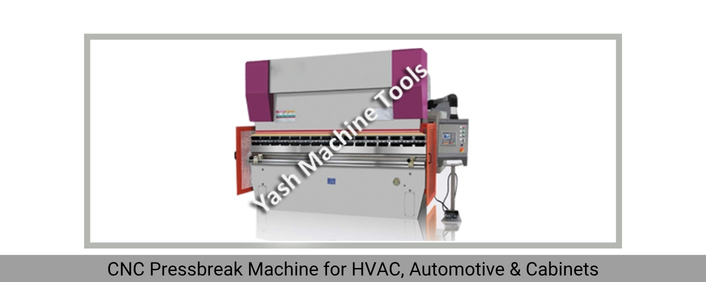
CNC Press Brake Machines in HVAC Manufacturing
The HVAC Fabrication Challenge
HVAC (Heating, Ventilation and Air Conditioning) ductwork and equipment manufacturing is one of the largest consumers of sheet metal bending capacity in Indian industry. Air handling units, duct sections, plenums, diffuser housings, fan casings, coil frames, and equipment enclosures all require precision bending of thin to medium gauge galvanised steel, stainless steel, and aluminium sheet.
The HVAC fabrication environment presents a specific set of challenges for press brake operations. Components are typically large in plan dimension — duct sections for commercial and industrial buildings can be 1000mm to 2000mm wide and longer. Material thicknesses range from 0.6mm to 2mm for standard ductwork up to 3mm or 4mm for heavy-duty industrial ducts and equipment housings. Bend angles must be consistent and repeatable across large production runs of identical components. And because HVAC components are often visible in the finished installation, cosmetic quality matters — marks from press brake tooling on visible faces are not acceptable.
 Call Now!
How CNC Press Brakes Serve HVAC Production
The CNC press brake machine addresses the HVAC industry’s requirements through several key capabilities. The programmable back gauge allows precise, repeatable positioning of the sheet for each bend in a multi-bend sequence, ensuring that all bends in a complex duct section land in exactly the right position relative to each other. Once the bend program for a duct section profile is written and proved, the CNC press brake machine can execute it consistently across the full production run with minimal operator skill involvement between setups.
For HVAC applications, the CNC bending machine’s ability to store and recall complete bend programs for every product in the range is particularly valuable. An HVAC fabricator may produce dozens of different duct section profiles in varying widths and lengths. A CNC press brake machine with stored programs allows the operator to call up the correct program for each product, automatically moving the back gauge to the correct position for each bend in the sequence.
The NC press brake machine and the CNC press brake machine are also used in HVAC for forming the longitudinal seams and flanges on duct sections that allow sections to be joined together in the field. These flanges require precise bend angle and dimension consistency to ensure airtight assembly — a slightly overbent or underbent flange will not seat correctly against its mating section and will leak.
Tooling Considerations for HVAC Bending
HVAC work places specific demands on press brake tooling. Because HVAC components are often pre-painted, pre-galvanised, or have coated surfaces that must not be scratched, tooling with smooth, polished punch and die faces is essential. Urethane or nylon inserts in the die are used for particularly delicate surfaces. The use of a CNC electro hydraulic synchronous press brake, which keeps the upper beam perfectly parallel to the lower die throughout the stroke, is especially valuable for long HVAC bends where any beam deflection would produce a bow in the centre of the bent flange.
For the wide ductwork common in large commercial HVAC installations, a press brake machine with a bed length of 2500mm or more is required. The CNC electro hydraulic synchronous press brake from Yash Machine Tools meets this requirement with its closed-loop synchronous beam control ensuring parallel descent across the full bed length.
Read Our Article
All Geared Lathe Machine Price Factors: What Actually Increases CostCNC Press Brake Machines in Automotive Manufacturing
The Automotive Bending Environment
The automotive industry is one of the most demanding environments for press brake operations. Automotive components — body reinforcements, brackets, seat frames, engine bay components, chassis sections, and suspension links — must meet tight dimensional tolerances to fit correctly in assembly and must do so consistently across very high production volumes. A bracket that is 1mm out of position will cause an assembly problem; a bracket that varies by 1mm between components will cause an assembly problem on every fourth or fifth vehicle.
The materials used in automotive sheet metal work are also increasingly challenging. High-strength steel (HSS) and advanced high-strength steel (AHSS) grades are now standard in body structural components because they allow thinner, lighter sections that meet crash performance requirements. These materials spring back significantly more than mild steel after bending, which means the punch must overbend the component to compensate so that it springs back to the correct angle. Managing springback in HSS and AHSS requires precise control of bend depth — exactly what a CNC press brake machine with high-resolution back gauge positioning and closed-loop angle control provides.
Bracket and Reinforcement Production
Sheet metal brackets and reinforcements are produced in very high volumes in the automotive supply chain. A single vehicle platform may use dozens of different bracket designs, each produced in quantities of hundreds of thousands per year. For this class of work, the press brake machine must deliver consistent results across the entire production run with minimal operator adjustment between components.
The CNC press brake machine in an automotive component facility is typically set up with a suite of tooling for the family of components produced on it and programmed with a complete library of bend programs for each component. When a production run changes, the operator calls up the new program, the back gauge repositions automatically, and production resumes within minutes. This rapid changeover capability is one of the key advantages of CNC press brake machines over manually controlled alternatives in high-mix automotive component production.
The hydraulic press brake with NC control is used in automotive facilities for simpler bracket families where the number of bends per component is low and the bend sequence is straightforward. For complex multi-bend components with tight tolerances, the full CNC press brake machine with automatic angle monitoring is the preferred choice.
Chassis and Structural Components
Automotive chassis brackets and structural section components are often bent from high-strength steel plate of 3mm to 8mm thickness, requiring significant press tonnage and precise springback compensation. The CNC electro hydraulic synchronous press brake is the machine of choice for these components because its closed-loop synchronous control maintains beam parallelism even under the high and asymmetric loads generated by bending thick, high-strength material.
The bending of automotive structural components also requires accurate documentation of the bend parameters used, since automotive supply chains require traceability of process parameters for quality management purposes. CNC press brake machines with data logging capability record the actual bend parameters for each component, supporting the quality documentation requirements of automotive Tier 1 and Tier 2 supply chain members.
Our Other Product
CNC Lathe MachinesQuality Requirements in Automotive Press Brake Work
Automotive component fabricators using press brake machines typically operate against tight angle tolerances of plus or minus 0.5 degrees or better. Achieving this tolerance consistently across a production run requires a CNC press brake machine with active angle measurement — a system that measures the actual bend angle during or immediately after bending and adjusts the bend depth to compensate for springback and material variation. Advanced CNC press brake machines include this capability as a standard feature, making consistent angle accuracy achievable without manual measurement and adjustment on every component.
CNC Press Brake Machines in Electrical Cabinet Manufacturing
The Electrical Cabinet Fabrication Requirement
Electrical switchgear panels, control cabinets, distribution boards, and equipment enclosures form one of the largest and fastest-growing markets for CNC press brake work in India, driven by the country’s rapid expansion of industrial capacity, commercial real estate, and power infrastructure. An electrical cabinet is a fabricated sheet metal enclosure that houses electrical distribution equipment, control systems, or electronic components and must meet dimensional, cosmetic, and structural requirements set by the end user and by applicable standards.
Electrical cabinets are typically fabricated from cold-rolled mild steel sheet of 1.5mm to 3mm thickness, finished with a powder coat or paint. Stainless steel cabinets are used in food processing, pharmaceutical, and outdoor applications. Aluminium enclosures are used where weight is a factor. The dimensional accuracy of the cabinet determines whether the door fits correctly, whether internal mounting rails and DIN rails align with their mounting holes, and whether two or more cabinets can be bolted together in a row to form an assembly.
Bend Sequence Planning for Cabinets
An electrical cabinet enclosure typically requires a significant number of bends — a standard floor-standing panel enclosure might require 12 to 20 bends to produce the body, base, and door from flat blanks. Bending the components in the correct sequence is critical: some bends must be made before others because the tooling cannot access the bend location after adjacent bends have been formed. CNC press brake machines with 3D bend simulation software allow the programmer to verify the complete bend sequence on screen before cutting any material, identifying tool clearance problems before they occur on the machine.
The CNC bending machine’s stored program capability is particularly valuable in electrical cabinet production because cabinet manufacturers typically produce the same product families repeatedly, with each cabinet model having its own set of bend programs for the body, door, sub-panels, and gland plates. Once programmed and proved, these programs can be recalled instantly for each production run, eliminating repeat programming effort and ensuring consistent results across every batch.
Flange, Return and Corner Bends
Electrical cabinet production involves several specific bend types that require careful CNC press brake setup. Return bends — where a flange is bent back parallel to the panel face to create a stiffening lip — require careful clearance management between the formed flange and the punch nose. The NC press brake machine and CNC press brake machine handle return bends well when tooling is selected with the correct punch nose radius and the bend sequence places the return bend last or uses special return bend tooling.
Corner bends on cabinets — where the same component must be bent in two planes at 90 degrees to each other — require accurate positioning of the sheet for each bend so that the corner geometry comes out correctly. The CNC back gauge with multiple back gauge fingers allows the sheet to be supported and positioned accurately for each bend even on large panels that would otherwise be difficult to handle.
Tolerances and Cosmetic Quality in Cabinet Production
Electrical cabinet manufacturers typically work to assembly tolerances of plus or minus 1mm on external dimensions and plus or minus 0.5mm on mounting hole positions relative to cabinet edges. Achieving these tolerances on a bent sheet metal enclosure requires consistent bend angles — a 0.5-degree error in a 90-degree bend on a 400mm flange produces a 3.5mm dimensional error at the top of the flange.
Cosmetic quality is also critical because electrical cabinets are the visible face of the electrical installation. Tool marks on the external faces of panels are not acceptable to most end users. Sheet metal fabricators producing electrical cabinets use press brake tooling with carefully maintained surface finishes and often apply protective film to the sheet surface before bending to prevent marking. The CNC electro hydraulic synchronous press brake’s precise, controlled beam descent minimises the risk of marking from uneven or jerky tool contact.
Our Other Product
All Geared Radial Drilling MachinesChoosing the Right CNC Press Brake Machine for Your Industry
Bed Length and Tonnage
The first specification to confirm is whether the machine’s bed length and rated tonnage are adequate for the largest components you need to produce. HVAC fabricators handling large duct sections typically need a bed length of 2500mm or more. Automotive bracket producers working with high-strength steel need higher tonnage per metre than HVAC or cabinet producers working with thinner mild steel. Electrical cabinet fabricators typically need moderate tonnage and bed lengths of 2000mm to 3000mm.
Back Gauge Configuration
The back gauge is one of the most productivity-determining specifications on a CNC press brake machine. For simple single-bend components, a basic single-axis back gauge is sufficient. For complex multi-bend components with varying flange dimensions, a multi-axis back gauge with Z-axis finger positioning and R-axis depth adjustment allows the machine to set up for each bend in a sequence automatically. HVAC, automotive, and cabinet manufacturers all benefit from multi-axis back gauge configurations.
Hydraulic Press Brake vs CNC Electro Hydraulic Synchronous Press Brake
The Hydraulic Press Brake is suitable for lower-volume production of simpler components where absolute angle accuracy is less critical and the operator can compensate for springback manually. The CNC Electro Hydraulic Synchronous Press Brake is the machine of choice for high-volume production, complex bend sequences, tight angle tolerances, and long bends on wide material where beam parallelism is critical. For HVAC, automotive, and cabinet manufacturers operating at significant production volumes, the CNC Electro Hydraulic Synchronous Press Brake delivers the consistency and productivity that manual and basic hydraulic machines cannot match.
Frequently Asked Questions About CNC Press Brakes in Industry Applications
What is the difference between an NC press brake and a CNC press brake machine?
An NC press brake machine uses a numerical control system to position the back gauge and control the bend depth, but typically requires the operator to manually load programs and has limited storage capacity. A CNC press brake machine has a full computer numerical control system with a graphical programming interface, large program storage, 3D bend simulation, and often automatic angle measurement and springback compensation. CNC press brake machines are more productive on complex, multi-bend components and high-mix production.
Why is the CNC electro hydraulic synchronous press brake preferred for long bends?
The CNC electro hydraulic synchronous press brake uses matched hydraulic cylinders on both sides of the beam with closed-loop servo position control to keep the upper beam perfectly parallel to the lower die throughout the bending stroke. On long bends this synchronisation prevents the centre of the beam from deflecting more than the ends, which would produce a bowed bend. For HVAC ductwork flanges, automotive chassis sections, and cabinet side panels where a long straight bend is required, beam parallelism is critical to dimensional accuracy.
How does a CNC press brake handle springback in high-strength steel?
Modern CNC press brake machines handle springback in high-strength steel through automatic angle measurement and compensation. The machine measures the actual bend angle during or immediately after bending using an integrated angle measurement system and automatically adjusts the punch depth to overbend the component by the amount required so that when it springs back it reaches the target angle. This closed-loop angle correction eliminates the trial-and-error process of manually testing and adjusting bend depth on each new material.
What press brake tonnage is needed for electrical cabinet production?
Most electrical cabinet production uses mild steel of 1.5mm to 3mm thickness. For a 2500mm bed length machine bending 3mm mild steel, a machine rated at 100 to 160 tonnes is typically adequate. Higher tonnage is required for wider bends and for stainless steel, which has higher tensile strength than mild steel and requires approximately 30 percent more bending force for the same thickness and bend length.
Can the same CNC press brake machine handle both HVAC and automotive work?
Yes, a well-specified CNC press brake machine can handle both HVAC and automotive work if its bed length, tonnage, back gauge configuration, and tooling range cover both applications. The key is ensuring the machine has sufficient bed length for the largest HVAC components, sufficient tonnage for the thickest automotive high-strength steel, and a tooling system flexible enough to accommodate the different punch and die profiles required for each product family.
How important is bend angle accuracy in electrical cabinet manufacturing?
Bend angle accuracy is critical in electrical cabinet manufacturing because dimensional errors on individual bends accumulate through a multi-bend component and can make it impossible to assemble the cabinet correctly. A CNC press brake machine with automatic angle measurement achieves consistent angles of plus or minus 0.5 degrees or better, which translates to dimensional accuracy well within the plus or minus 1mm assembly tolerance typically required for standard electrical enclosures.
Conclusion
The CNC press brake machine serves three of India’s most important and fastest-growing manufacturing sectors — HVAC fabrication, automotive component production, and electrical cabinet manufacturing — but it serves each one differently. HVAC fabricators need long bed lengths, surface-friendly tooling, and stored programs for large component families. Automotive manufacturers need tight angle control, springback compensation for high-strength steels, and rapid changeover capability. Electrical cabinet producers need precise multi-bend sequence programming, cosmetic-quality tooling, and dimensional consistency across complex enclosure geometries.
The Hydraulic Press Brake from Yash Machine Tools suits lower-volume and simpler applications across all three sectors. The CNC Electro Hydraulic Synchronous Press Brake is the machine of choice when production volumes are high, bend sequences are complex, tolerances are tight, or bends are long. Understanding which machine matches your specific production requirements is the foundation of a press brake investment that delivers consistent quality and strong return on capital for years to come.

Mr. Yash Shah brings extensive knowledge of workshop machinery and precision engineering to his writing, drawing on years of hands-on exposure to the machine tools industry. He writes on a broad spectrum of equipment, including Lathe Machines, Radial Drilling Machines, Milling Machines, CNC Machines, Grinding Machines, Boring Machines, Planing Machines, and other workshop machinery essential to modern manufacturing. His articles focus on practical applications, machine selection, and the role these tools play in improving shop-floor efficiency and production quality. Mr. Shah is associated with Yash Machine Tools, a trusted name in the manufacturing and supply of workshop machinery, known for delivering reliable, industry-grade solutions to clients across India and abroad.
Summarize with AI:




Listen Article:
- Hydraulic Shearing Machine: Common Problems, Causes and Solutions
- How to Maintain a Lathe Machine: Daily, Weekly and Monthly Checklist
- Heavy-Duty Lathe vs. Medium-Duty Lathe: Which One Does Your Manufacturing Unit Need?
- Planing Machines and CNC Cutting Machines: Types, Features and Industrial Applications
- Welding Machines: Types, Applications and How to Choose the Right Welder for Your Workshop