Welding Machines: Types, Applications and How to Choose the Right Welder for Your Workshop
Overview: Why the Right Welding Machine Matters
Welding is one of the most widely performed fabrication processes in Indian manufacturing. From automotive body shops and structural steel fabricators to shipyards, pipeline contractors, construction companies, and general engineering workshops, the welding machine is a piece of equipment that almost every production facility depends on every single working day. The range of welding machines available today is broader than ever, covering everything from large industrial MIG welding machines used in automated automotive production lines to compact portable DC inverter welding machines that tradespeople carry to remote worksites.
Understanding the differences between welding machine types, their respective strengths, and the applications they are best suited to is essential for any workshop or fabrication facility evaluating its welding equipment. This article covers the major welding machine categories available in the Indian market, the key technologies behind each one, and the factors that should guide your choice of welder machine for your specific application.
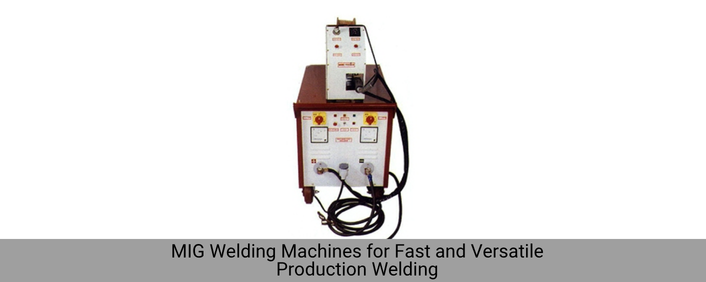
MIG Welding Machines: Speed and Versatility for Production Welding
What Is a MIG Welding Machine?
The MIG welding machine, which stands for Metal Inert Gas welding, is one of the most popular and widely used welding machine types in Indian manufacturing. A MIG welding machine feeds a continuous wire electrode through a welding gun, with an inert or active shielding gas protecting the weld pool from atmospheric contamination. The continuous wire feed is the key feature that makes the MIG welding machine so productive: unlike stick welding processes that require the operator to stop and change electrode rods frequently, a MIG welding machine maintains a long arc time without interruption, dramatically improving welding speed and operator efficiency.
 Call Now!
Applications of MIG Welding Machines
MIG welding machines are particularly well suited to high-speed production welding on mild steel, stainless steel, and aluminium. The ability to weld in multiple positions, on materials of varying thickness, and on components with complex geometry makes the MIG welding machine the first choice in automotive manufacturing, general fabrication, pressure vessel production, and structural steel work. MIG welding machines are also easier to learn than TIG or MMA processes, which makes them a practical choice for workshops that need to train new welding operators quickly.
MAG and CO2 Welding Machines
The MIG welding machine can also be configured for MAG (Metal Active Gas) welding, where an active gas mixture such as CO2 or a CO2 and argon blend is used as the shielding gas instead of a pure inert gas. The MAG welding machine process is widely used for welding mild steel because the active gas produces a more stable arc and better penetration than pure inert gas on ferrous materials, while keeping shielding gas costs lower than pure argon.
The CO2 welding machine is a specific variant of the MAG process that uses pure carbon dioxide as the shielding gas. CO2 welding machines are extremely popular in Indian workshops for mild steel fabrication because CO2 is significantly less expensive than argon-based gas mixtures, making the CO2 welding machine one of the most cost-effective options for high-volume steel welding. The weld produced by a CO2 welding machine tends to have more spatter than argon-mixed processes, but for structural and general fabrication work where post-weld grinding is acceptable, the CO2 welding machine delivers excellent productivity at the lowest operating cost.
Read Our Article
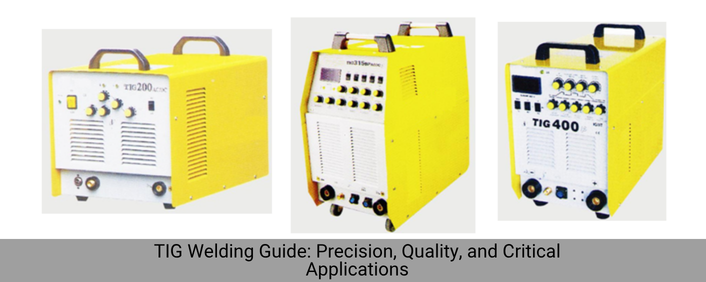
All Geared Lathe Machine Price Factors: What Actually Increases CostTIG Welding Machines: Precision and Quality for Critical Applications
What Is a TIG Welding Machine?
The TIG welding machine, which stands for Tungsten Inert Gas welding, produces the highest quality welds of any arc welding process and is the preferred choice wherever weld quality, appearance, and metallurgical integrity are critical requirements. A TIG welding machine works by producing an arc between a non-consumable tungsten electrode and the workpiece, with a separate filler rod fed into the weld pool by hand. The entire weld zone is protected by an inert shielding gas, typically argon, which surrounds the arc and weld pool to prevent oxidation and contamination.
Why Choose a TIG Welding Machine?
The TIG welding machine produces welds with no spatter, minimal distortion, excellent fusion, and a clean, precise bead profile that requires no post-weld treatment in most applications. This combination of qualities makes the TIG welding machine the standard choice in aerospace manufacturing, pharmaceutical and food processing equipment, nuclear and power generation components, automotive exhaust systems, and anywhere else that weld quality cannot be compromised.
TIG welding machines are particularly well suited to welding aluminium, stainless steel, nickel alloys, titanium, and other difficult materials that require careful control of heat input and shielding to produce sound, high-quality welds. The TIG process also excels at welding thin materials where the precise control over heat input that TIG welding machines provide is essential to avoid burn-through and distortion.
Industrial Applications of TIG Welding Machines
Among the most important applications of TIG welding machines in Indian industry are the fabrication of stainless steel process equipment for food, pharmaceutical, and chemical plants; the production of aluminium structures for the automotive, aerospace, and defence industries; and the welding of nickel alloy and exotic metal components for power generation and petrochemical applications.
Our Other Product
CNC Lathe MachinesMMA Welding Machines: Reliable, Versatile Stick Welding for Every Environment
What Is a MMA Welding Machine?
The MMA welding machine, which stands for Manual Metal Arc welding and is also known as stick welding, is the oldest and most widely used arc welding process in the world. A MMA welding machine strikes an arc between a consumable coated electrode (the welding rod) and the workpiece, melting both the electrode and the parent material to form the weld. The coating on the electrode provides the shielding gases and slag that protect the weld pool during welding.
Where Are MMA Welding Machines Used?
MMA welding machines are valued for their simplicity, robustness, and ability to work effectively in environments where other welding processes would struggle. Unlike MIG and TIG welding machines that require an external shielding gas supply, a MMA welding machine needs only electricity and electrode rods, making it ideal for site work, remote locations, outdoor welding, and maintenance applications where carrying gas cylinders is impractical or impossible.
MMA welding machines are used across construction, structural steel erection, pipeline welding, maintenance and repair workshops, shipbuilding, and general fabrication. They can weld carbon steel, stainless steel, cast iron, and many alloy steels using appropriate electrodes, and they are capable of welding in all positions including overhead, which makes them the most versatile welding process for site and maintenance work.
DC Inverter Welding Machines: Modern Technology for Better Performance and Portability
What Is a DC Inverter Welding Machine?
The DC inverter welding machine represents the most significant technological advance in welding machine design of recent decades. Traditional transformer-based welding machines use large, heavy transformers to convert mains AC power to the lower voltage, high-current output required for welding. A DC inverter welding machine replaces the heavy transformer with a compact electronic inverter circuit that operates at high frequency, converting the input power far more efficiently and in a much smaller, lighter package.
Key Advantages of DC Inverter Welders
The advantages of the DC inverter welding machine over traditional transformer-based machines are substantial. A DC inverter welding machine consumes significantly less power for the same welding output, which reduces electricity costs and makes it suitable for use on sites with limited power supply. The stable DC output of an inverter welder provides easier, more reliable arc starting and a smoother, more consistent arc during welding, producing better quality welds with less spatter and easier control. The compact, lightweight design of the DC inverter welding machine makes it easy to transport to different workstations or remote sites, opening up applications that would be impractical with a heavy transformer machine.
DC Inverter Welder Series at Yash Machine Tools
The DC inverter welder machine is available across a wide range of output capacities and series, each designed for specific applications and environments.
The MMA-D series DC inverter welders are compact, stable, and durable units designed for general arc welding applications. They offer easy arc starting, smooth welding performance, and precise weld quality on a range of materials at a cost-effective price point that makes them accessible to small workshops and individual tradespeople as well as larger production facilities.
The MMA-W series DC inverter welder machine delivers energy-efficient operation with a stable arc and minimal spatter. It features an automatic protection system that manages high-voltage fluctuations automatically, making it reliable even in environments with unstable power supply. The strong arc force at all operating conditions makes it suitable for deep penetration welding on structural applications. It is widely used for welding stainless steel and iron.
The MMA-E series DC inverter welding machine is a portable yet powerful unit designed for applications that combine high production demands with the need for mobility. Its compact size and energy-saving design make it suitable for demanding work at height, in confined spaces, decoration works, and maintenance applications where carrying a heavy machine is not practical.
The MMA-P series welder machine offers continuous welding capability with automatic high-voltage protection, making it reliable for extended welding sessions and suitable for all standard welding rods and electrodes. Its light weight and energy efficiency make it one of the most practical choices for contractors and fabricators who move between different worksites.
The MMA-X series DC inverter welder machine is designed for demanding applications that require deep penetrating welds and reliable long-term performance. It delivers excellent arc starting, strong arc force, and consistent weld quality on a wide range of materials, with low power consumption and minimal defects even in challenging welding conditions.
The MMA-M series welder machine is a portable, high-efficiency unit that handles a wide range of materials including carbon steel, alloy steel, stainless steel, and cast iron. It is used in industries as diverse as medicine, cement production, metallurgy, and mining, where reliable welding capability across varied materials and environments is required.
The MMA-MINI series welding machine is the most compact and lightweight DC inverter welder in the range, available with an optional carry case for maximum portability. Despite its small size, it delivers the same energy efficiency, precise arc force, and auto-protection features as larger models, making it the ideal choice for welders who work at different locations and need a capable welder machine they can carry wherever the work takes them.
How to Choose the Right Welding Machine for Your Application
Match the Process to the Material and Quality Requirement
For high-volume production welding on mild steel, stainless steel, or aluminium where speed and operator efficiency are the priority, the MIG welding machine is the natural choice. For applications where weld quality is paramount and the materials are difficult or the joint configuration is demanding, the TIG welding machine delivers the precision and quality that no other process can match. For site work, maintenance, outdoor applications, and environments where shielding gas supply is impractical, the MMA welding machine or a DC inverter welder machine is the most practical and versatile option.
Consider Power Supply and Portability
Consider the power supply available at your worksite or workshop. DC inverter welding machines are more power-efficient than transformer-based alternatives and can often operate satisfactorily on lower-capacity power supplies, making them better suited to sites with limited electrical infrastructure. If your welders move between different worksites or work in locations where carrying equipment is difficult, a compact DC inverter welder machine or an MMA-MINI series machine gives you full welding capability in the most portable package available.
Match the Shielding Gas to the Metal
Consider the materials you weld most frequently. MIG and CO2 welding machines are optimised for mild steel. TIG welding machines are the preferred choice for aluminium, stainless steel, and exotic alloys. MMA welding machines and DC inverter welders handle the broadest range of materials using appropriate electrode selection.
Frequently Asked Questions About Welding Machines
What is the difference between MIG and TIG welding machines?
A MIG welding machine uses a continuously fed wire electrode and shielding gas to weld at high speed, making it ideal for production welding on mild steel, stainless steel, and aluminium. A TIG welding machine uses a non-consumable tungsten electrode and a separately hand-fed filler rod, producing higher quality, cleaner welds with no spatter. TIG is preferred for precision work, thin materials, and difficult alloys where weld quality is critical.
What is a CO2 welding machine used for?
A CO2 welding machine uses pure carbon dioxide as the shielding gas in a MIG-type process. It is primarily used for welding mild steel in fabrication, structural, and general engineering applications. The CO2 welding machine is one of the most cost-effective options for high-volume mild steel welding because CO2 is significantly less expensive than argon-based gas mixtures.
What is a DC inverter welder and why is it better than a transformer welder?
A DC inverter welder uses high-frequency electronic inverter technology to convert input power far more efficiently than a traditional transformer-based welding machine. The result is a lighter, more compact machine that consumes less power, provides more stable arc performance, starts more easily, and produces better quality welds with less spatter. DC inverter welders are also more portable, making them suitable for both workshop and site applications.
Which welding machine is best for stainless steel?
The TIG welding machine is generally the preferred choice for stainless steel where weld quality and appearance are important, as it produces clean, spatter-free welds with excellent corrosion resistance. For production welding of stainless steel where speed is the priority, a MIG welding machine with appropriate stainless wire and argon-based shielding gas is also widely used. The MMA-W series DC inverter welder machine is also specified for stainless steel welding.
What is a MAG welding machine?
A MAG welding machine, which stands for Metal Active Gas welding, uses an active shielding gas such as CO2 or a CO2 and argon mixture instead of a pure inert gas. The MAG welding machine process is widely used for mild steel fabrication and structural steel work in Indian industry, producing stable arcs and good penetration at a lower shielding gas cost than pure argon processes.
Can a MMA welding machine be used outdoors?
Yes, the MMA welding machine is one of the most suitable welding processes for outdoor and site work because it does not require an external shielding gas supply. The coating on the MMA electrode provides its own shielding and slag protection, making the MMA welding machine effective even in windy or open-air conditions where shielding gas coverage would be disrupted.
How do I choose between the different MMA-series DC inverter welders?
The right MMA series depends on your production requirements and working environment. For general workshop arc welding, the MMA-D series offers excellent value. For applications requiring deep penetration and high arc force, the MMA-W or MMA-X series is more appropriate. For continuous production use across a range of materials, the MMA-M series is a strong choice. For maximum portability, the MMA-MINI series with its optional carry case is the most practical option.
Conclusion
The welding machine in all its forms — from the productive MIG welding machine and the precision TIG welding machine to the versatile MMA welding machine and the energy-efficient DC inverter welder machine — is an indispensable tool in Indian manufacturing and fabrication. Whether you need a CO2 welding machine for high-volume mild steel production, a MAG welding machine for structural fabrication, a TIG welding machine for critical aerospace and pharmaceutical work, or a portable DC inverter welding machine for site and maintenance applications, the right welder machine will deliver the quality, productivity, and reliability your workshop demands.
Investing in the correct welding machine for your application, from the right process technology to the right output capacity and portability level, is one of the most impactful equipment decisions any fabrication workshop can make. The right welder machine makes your operators more productive, your welds more consistent, and your overall fabrication quality stronger.

Mr. Yash Shah brings extensive knowledge of workshop machinery and precision engineering to his writing, drawing on years of hands-on exposure to the machine tools industry. He writes on a broad spectrum of equipment, including Lathe Machines, Radial Drilling Machines, Milling Machines, CNC Machines, Grinding Machines, Boring Machines, Planing Machines, and other workshop machinery essential to modern manufacturing. His articles focus on practical applications, machine selection, and the role these tools play in improving shop-floor efficiency and production quality. Mr. Shah is associated with Yash Machine Tools, a trusted name in the manufacturing and supply of workshop machinery, known for delivering reliable, industry-grade solutions to clients across India and abroad.
Summarize with AI:




Listen Article:
- Heavy-Duty Lathe vs. Medium-Duty Lathe: Which One Does Your Manufacturing Unit Need?
- Planing Machines and CNC Cutting Machines: Types, Features and Industrial Applications
- Types of Workshop Machinery: Milling, Grinding, Bandsaw and Tool Room Machines Explained
- Sheet Metal Machines: Types, Applications and How to Choose the Right One
- Drill Machine: Types of Drilling Machines and Their Industrial Applications