


Flat Bed CNC Lathe vs. Slant Bed CNC Lathe: Which One Is Right for Your Machining Needs?
Selecting the right CNC lathe machine is a crucial decision for manufacturers aiming to balance productivity, accuracy, and long-term profitability. Among the most common choices in CNC turning centers are Flat Bed CNC Lathes and Slant Bed CNC Lathes. While both machines perform turning operations with high precision, their design philosophies, performance characteristics, and ideal applications differ significantly.
At Yash Machine Tools, we manufacture and supply both flat bed and slant bed CNC lathe machines to meet diverse industrial requirements. This article provides an in-depth comparison to help you determine which CNC lathe configuration best suits your machining needs.
Understanding the Importance of Bed Design in CNC Lathe Machines
The bed is the foundation of any CNC lathe. It supports all major components such as the spindle, carriage, turret, and tailstock. Bed design directly affects:
- Machine rigidity
- Machining accuracy
- Chip evacuation
- Automation compatibility
- Long-term stability under load
The key structural difference between flat bed and slant bed CNC lathes lies in how the bed is oriented—and that orientation changes how the entire machine behaves during operation.
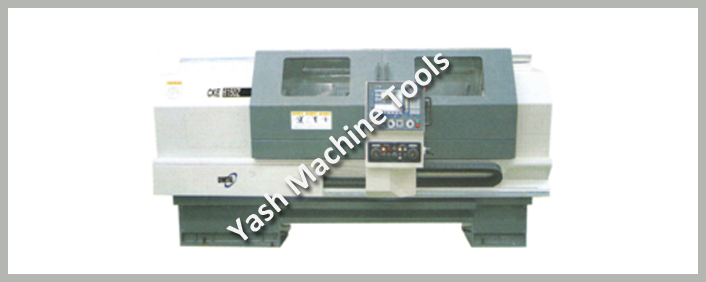
What Is a Flat Bed CNC Lathe Machine?
A Flat Bed CNC Lathe features a horizontally aligned bed where the guideways run parallel to the ground. This traditional design is known for its robustness and stability, especially when machining large and heavy workpieces.
Key Characteristics of Flat Bed CNC Lathes
- Horizontal bed structure
- High rigidity and load-bearing capacity
- Suitable for large-diameter and long components
- Simple machine layout
- Easy maintenance and accessibility
Flat bed CNC lathes are widely used in industries where cutting forces are high and component weight is substantial.
Typical Applications of Flat Bed CNC Lathe Machines
Flat bed CNC lathes are ideal for:
- Heavy engineering components
- Oil and gas parts such as shafts, flanges, and couplings
- Power plant components
- Large pipes and cylindrical workpieces
- Job work involving varied part sizes
Their ability to handle high cutting loads makes them a trusted choice in heavy-duty machining.

Advantages of Flat Bed CNC Lathe Machines
Superior Load Handling
The flat bed design distributes weight evenly, allowing the machine to handle heavy and oversized components without compromising stability.
High Structural Rigidity
Flat beds offer excellent vibration damping, which is critical when machining tough materials like alloy steel or cast iron.
Cost-Effective Investment
Flat bed CNC lathes generally have a lower initial cost compared to slant bed machines, making them suitable for small to medium-scale manufacturing units.
Easy Maintenance
The open and simple structure makes servicing, alignment, and inspection easier.
Limitations of Flat Bed CNC Lathes
While robust, flat bed CNC lathes do have some limitations:
- Chip removal is less efficient, especially in high-speed machining
- Operator intervention is often required to clear chips
- Less suitable for complex automation
- Lower productivity in mass production environments
What Is a Slant Bed CNC Lathe Machine?
A Slant Bed CNC Lathe features a bed inclined at an angle (typically 30° to 45°). This modern design is optimized for high-speed, high-precision, and automated machining.
The slanted orientation allows gravity-assisted chip flow, keeping the machining area clean and improving overall efficiency.
Key Features of Slant Bed CNC Lathes
- Angled bed design
- Compact machine footprint
- Better chip evacuation
- Enhanced operator ergonomics
- Advanced automation compatibility
Slant bed CNC lathes are widely used in industries that demand tight tolerances, fine surface finish, and high production rates.
Typical Applications of Slant Bed CNC Lathe Machines
Slant bed CNC lathes excel in:
- Automotive component manufacturing
- Aerospace precision parts
- Hydraulic and pneumatic fittings
- Medical and precision engineering components
- Mass production and batch manufacturing
Advantages of Slant Bed CNC Lathe Machines
Efficient Chip Management
Gravity helps chips fall away from the cutting zone, reducing tool wear and improving surface finish.
Higher Machining Accuracy
The slanted structure improves stiffness in critical machining directions, resulting in better dimensional accuracy.
Faster Cycle Times
Optimized layout and automated tool turrets enable rapid tool changes and high spindle speeds.
Operator-Friendly Design
The inclined bed provides better visibility and easier access to the work zone.
Automation Ready
Slant bed CNC lathes integrate seamlessly with bar feeders, robotic loaders, and Industry 4.0 systems.
Limitations of Slant Bed CNC Lathes
Despite their advantages, slant bed machines may not be suitable in all scenarios:
- Higher initial investment
- Slightly reduced load capacity compared to flat bed designs
- Not always ideal for very large or extremely heavy workpieces
Flat Bed vs. Slant Bed CNC Lathe: Comparison Table
| Feature | Flat Bed CNC Lathe | Slant Bed CNC Lathe |
| Bed Orientation | Horizontal | Inclined (30°–45°) |
| Load Capacity | Very high | Moderate to high |
| Chip Evacuation | Manual/limited | Gravity-assisted |
| Production Type | Job work / heavy-duty | Mass & precision production |
| Automation | Limited | Excellent |
| Surface Finish | Good | Excellent |
| Initial Cost | Lower | Higher |
| Maintenance | Easy | Moderate |
Performance Comparison: Accuracy, Productivity & Tool Life
Machining Accuracy
Slant bed CNC lathes generally offer better accuracy due to optimized force distribution and reduced chip interference.
Productivity
For high-volume production, slant bed machines outperform due to faster cycle times and automation capabilities.
Tool Life
Improved chip flow and coolant access in slant bed machines extend tool life compared to flat bed lathes.
Cost, ROI & Long-Term Value
Flat Bed CNC Lathe
- Lower purchase cost
- Ideal for varied and heavy jobs
- Longer machining cycles but lower investment risk
Slant Bed CNC Lathe
- Higher upfront cost
- Higher output per shift
- Better ROI for mass production environments
The right choice depends on production volume, component size, and future expansion plans.

How to Choose the Right CNC Lathe for Your Business?
Ask yourself the following:
- Are my components large and heavy, or small and high-precision?
- Is my production job-based or continuous mass production?
- Do I plan to automate loading and unloading?
- What level of surface finish do my customers expect?
- What is my long-term production growth plan?
Your answers will clearly indicate whether a flat bed CNC lathe or a slant bed CNC lathe is the better fit.
CNC Lathe Machine Solutions from Yash Machine Tools
At Yash Machine Tools, we manufacture reliable Flat Bed CNC Lathes for heavy-duty turning and advanced Slant Bed CNC Lathes for precision and high-speed production.
Our machines are built with:
- Rigid cast-iron structures
- Precision guideways
- Advanced CNC control compatibility
- Durable spindles and turrets
- Strong after-sales and technical support
Whether your requirement is robustness or productivity, we offer CNC lathe machines tailored to your machining needs.
Conclusion
Both Flat Bed CNC Lathes and Slant Bed CNC Lathes play vital roles in modern manufacturing—but they serve different purposes. Flat bed CNC lathes are best for heavy-duty, large-component machining, while slant bed CNC lathes excel in precision, speed, and automation.
Choosing the right CNC lathe machine is about aligning machine capability with your production goals. With the right selection and a reliable manufacturer like Yash MachineTools, your CNC turning operations can achieve higher efficiency, accuracy, and profitability.
- All Geared Radial Drilling Machines for Gulf Industries: Built for Heavy-Duty Precision
- CNC Press Brake Machines: Powering Precision Sheet Metal Bending in Modern Manufacturing
- CNC Bending Machines: A Complete Guide to Modern Sheet Metal Bending Technology
- Choosing Between Conventional and CNC Press Brakes: A Technical Comparison
- Maintaining a Chamfer Machine: Tips for Prolonged Accuracy and Performance


