Heavy-Duty Lathe vs. Medium-Duty Lathe: Which One Does Your Manufacturing Unit Need?
Introduction: Why Choosing the Right Lathe Capacity Matters
Buying a lathe machine is one of the most significant capital investments a manufacturing unit will make. Get the capacity right and the machine pays for itself many times over through reliable, productive output for decades. Get it wrong and you either overload a machine that cannot handle your work, or you tie up capital in a machine far larger than your production requires.
The most common decision point for Indian manufacturing units evaluating a lathe machine purchase is the choice between a heavy duty lathe machine and a medium duty lathe machine. Both are serious industrial machines. Both are used across Indian manufacturing every day. But they are designed for fundamentally different classes of work, and choosing the wrong one for your application is a mistake that is expensive and slow to correct.
This article gives you a clear, detailed comparison of heavy duty lathe machines and medium duty lathe machines, covering their construction, capabilities, applications, and the specific production scenarios where each one is the right answer.
Understanding Lathe Machine Capacity Categories
How Lathe Machines Are Classified by Duty
Lathe machine manufacturers classify their ranges by duty category, which is a shorthand for the combination of workpiece size, material weight, spindle power, and production intensity the machine is built to handle. The four main categories in the Indian market are light duty, medium duty, heavy duty, and extra heavy duty, with each representing a step up in machine size, structural rigidity, spindle power, and load-bearing capacity.
Understanding what each duty category means in practical terms is essential before comparing machines across categories. A heavy duty lathe machine is not simply a bigger medium duty machine. It is a machine built to a fundamentally different structural specification, with a heavier bed, a more powerful headstock, a larger spindle bore, and a drive system designed for continuous operation under high cutting loads.
What Determines Duty Rating?
The key specifications that determine a lathe machine’s duty rating are swing over bed (the maximum diameter of workpiece that can be rotated), distance between centres (the maximum length of workpiece that can be mounted), spindle bore diameter (the maximum diameter of bar stock that can be passed through the spindle), spindle motor power, and the weight and rigidity of the machine bed and headstock castings.
Heavy duty lathe machines have larger values across all of these specifications compared to medium duty machines, and they are built with heavier castings designed to absorb the greater cutting forces generated when turning large, heavy workpieces at the material removal rates that production efficiency demands.
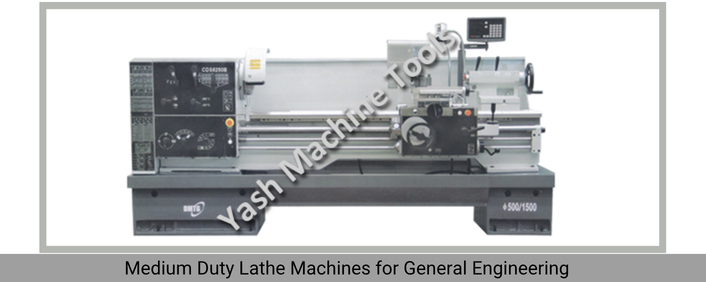
Medium Duty Lathe Machines: The Production Workhorse for General Engineering
What Is a Medium Duty Lathe Machine?
A medium duty lathe machine bridges the gap between the compact light duty machines used in training institutes and small workshops, and the large, powerful heavy duty machines used in heavy engineering and capital equipment manufacturing. A medium duty lathe machine is designed for sustained production use on components of moderate size and weight, in materials ranging from mild steel and aluminium to stainless steel and cast iron.
The medium duty lathe machine typically offers a swing over bed in the range of 300mm to 500mm and a distance between centres of 750mm to 2000mm, making it capable of handling a wide range of shaft, sleeve, flange, and component sizes that represent the bulk of turning work in general engineering. Spindle motor power is typically in the range of 3kW to 7.5kW, sufficient for productive turning in most common engineering materials without the higher power and operating cost of a heavy duty machine.
Who Uses Medium Duty Lathe Machines?
Medium duty lathe machines are the standard choice across a wide range of Indian manufacturing and engineering operations. Pump and valve manufacturers use medium duty lathes to machine shafts, impellers, and housings across a range of sizes. Automotive component suppliers use them for shafts, spindles, hubs, and housings that fall within the medium size range. General engineering workshops and job shops depend on medium duty lathes for the broad variety of turning work that comes in from customers across different industries.
Medium duty lathe machines are also the standard choice for maintenance and repair workshops in large industrial facilities, where worn shafts, worn bores, and damaged components across a wide range of sizes need to be machined back to specification. The medium duty machine’s combination of range and versatility makes it the practical first choice for maintenance turning departments in steel plants, cement factories, paper mills, and similar large industrial users.
Key Advantages of Medium Duty Lathe Machines
The medium duty lathe machine’s strengths relative to a heavy duty machine are lower purchase cost, lower operating cost, smaller footprint, and the flexibility to handle a wide range of component sizes efficiently without the overhead of running a larger machine. For workshops where the majority of work involves components in the medium size range and occasional larger pieces can be managed by adjusting the machining approach, the medium duty lathe machine delivers the best balance of capability, cost, and floor space.
All geared lathe machines in the medium duty category are particularly popular in Indian workshops because the all geared drive system provides a wide range of spindle speeds and feed rates through the gearbox, eliminating the slippage and power loss of belt-driven alternatives and making the machine more productive across the full range of materials and diameters it handles.
 Call Now!
Heavy Duty Lathe Machines: Built for the Demands of Heavy Engineering
What Is a Heavy Duty Lathe Machine?
A heavy duty lathe machine is a machine tool built specifically for continuous production use on large, heavy workpieces in demanding industrial environments. Where a medium duty lathe machine is versatile across a range of component sizes, a heavy duty lathe machine is optimised for sustained, high-load operation on the larger end of the turning spectrum.
A heavy duty lathe machine typically offers a swing over bed of 500mm and above, often extending to 800mm, 1000mm, or larger on the most capable models. The distance between centres ranges from 2000mm upwards, with many heavy duty models offering 3000mm, 4000mm, or even longer centre distances for machining long shafts, rollers, and other extended components. Spindle motor power is typically 11kW and above, with large heavy duty machines running 22kW, 30kW, or higher to maintain productive cutting speeds in tough materials on large diameters.
Construction Differences That Matter
The most important difference between a heavy duty lathe machine and a medium duty machine is not the specifications on the sheet but the construction quality and structural integrity of the machine itself. A heavy duty lathe machine is built with a substantially heavier bed casting, typically ribbed and stress-relieved to maximise rigidity and minimise vibration under high cutting loads. The headstock on a heavy duty machine is a more massive casting housing larger, more heavily loaded spindle bearings that maintain accuracy under the thrust forces generated by heavy turning operations.
The bed guideways on a heavy duty lathe machine are wider and longer than on a medium duty machine, providing a more stable platform for the carriage and tailstock across the full range of centre distances the machine offers. On quality heavy duty lathe machines, the guideways are hardened and precision ground to maintain accuracy over the machine’s working life even under continuous heavy use.
Who Uses Heavy Duty Lathe Machines?
Heavy duty lathe machines are found in the most demanding turning applications in Indian industry. Shipbuilding and ship repair facilities use heavy duty lathes to machine propeller shafts, rudder stocks, and other large marine components that can weigh several tonnes and measure several metres in length. Power generation facilities use heavy duty lathes to machine turbine rotors, generator shafts, and large valve bodies for steam and hydro power plants. Rolling mills and steel plants use heavy duty lathes to turn and re-grind rolling mill rolls that are massive, heavy, and require high material removal rates to be machined economically.
Paper mills and textile machinery manufacturers use heavy duty lathes for large rolls, cylinders, and shafts. Oil and gas equipment manufacturers use them for large flanges, valve bodies, and pressure vessel components. Defence manufacturing uses heavy duty lathes for large gun barrels, armoured vehicle components, and naval equipment.
The extra heavy duty lathe extends this capability even further, with bed lengths that can accommodate workpieces of 6 metres, 8 metres, or more between centres, and spindle bores wide enough to accept large hollow components. Extra heavy duty lathes are found in the most demanding heavy engineering environments and represent the maximum capability available in conventional lathe machine technology.
Head-to-Head Comparison: Heavy Duty vs Medium Duty Lathe Machine
Workpiece Size and Weight
The most fundamental difference is the size and weight of workpiece each machine can handle. A medium duty lathe machine handles components up to approximately 500mm swing and 2000mm between centres, covering the vast majority of general engineering turning work. A heavy duty lathe machine handles components from 500mm swing upwards, with centre distances of 2000mm to 6000mm or more, covering the large and very large components used in heavy engineering, power generation, shipbuilding, and large capital equipment manufacturing.
If your heaviest regular workpiece fits comfortably within the medium duty range, a heavy duty machine gives you capacity you will rarely use and costs you more in purchase price, floor space, power consumption, and operating expense. If your work regularly exceeds the medium duty range, a medium duty machine will be overloaded and will wear out quickly while producing poor results.
Spindle Power and Material Removal Rate
A heavy duty lathe machine has significantly more spindle motor power than a medium duty machine, which translates into the ability to take heavier cuts at higher feed rates on large-diameter workpieces. For a workshop that needs to remove large volumes of material from big components efficiently, the higher power of a heavy duty lathe machine is not an excess — it is a necessity.
On smaller diameter workpieces, however, a heavy duty machine’s extra power is largely unused, and the machine operates less efficiently in that range than a medium duty machine optimised for smaller diameters would. For a workshop that predominantly machines small to medium components, running a heavy duty lathe machine for that work is neither necessary nor economical.
Purchase Cost and Operating Cost
A heavy duty lathe machine costs significantly more than a comparable quality medium duty lathe machine, both in purchase price and in ongoing operating cost. The higher purchase price reflects the greater quantity and quality of materials used in the heavier castings, larger spindle bearings, more powerful motor, and more robust drive system. The higher operating cost reflects the greater power consumption of the larger motor and the higher cost of consumables and spare parts for a larger machine.
For a workshop that genuinely needs heavy duty capacity, this higher cost is justified by the productivity and capability the machine delivers. For a workshop that does not regularly work on heavy duty sized components, the extra cost is wasted expenditure that would be better directed at a higher specification medium duty machine or additional tooling and capacity.
Floor Space and Foundation Requirements
A heavy duty lathe machine requires significantly more floor space than a medium duty machine and typically requires a more substantial foundation to support its greater weight and absorb the higher vibration levels generated during heavy cutting. For workshops with limited floor area or existing foundations not designed for heavy machine tools, the installation requirements of a heavy duty lathe machine may be a practical constraint that influences the decision.
Medium duty lathe machines have more modest floor space and foundation requirements and can typically be installed in a wider range of existing workshop environments without major civil work.
How to Decide: A Practical Framework
Step 1: Define Your Largest Regular Workpiece
The most important starting point is defining the largest workpiece you regularly need to machine, not the largest you have ever handled or might theoretically handle in the future. Base your decision on the work that represents 80 to 90 percent of your actual production volume. A machine specified for your true regular work will serve you far better than a machine specified for a rare exceptional job.
Step 2: Check Swing and Centre Distance Requirements
Once you know your largest regular workpiece, check whether it falls within the medium duty range (up to approximately 500mm swing, 2000mm between centres) or requires heavy duty capacity (above 500mm swing or above 2000mm between centres). If your work sits comfortably within the medium duty range, a quality medium duty lathe machine is the right choice. If your work regularly exceeds these parameters, you need a heavy duty lathe machine.
Step 3: Consider Your Material and Removal Rate Requirements
If you regularly turn large diameters in tough materials such as alloy steel, stainless steel, or hard cast iron at production rates that demand high spindle torque, a heavy duty lathe machine’s greater motor power and structural rigidity will deliver better results and longer machine life than a medium duty machine pushed beyond its design envelope.
Step 4: Factor in Total Cost of Ownership
Consider not just the purchase price but the total cost of ownership including power consumption, floor space, foundation cost, maintenance, and spare parts availability. For many Indian manufacturing units, a quality medium duty all geared lathe machine that is correctly specified for the work delivers better return on investment than a heavy duty machine that is oversized for the typical production mix.
Frequently Asked Questions
What is the main difference between a heavy duty lathe machine and a medium duty lathe machine?
A heavy duty lathe machine is built for larger workpieces, heavier cutting loads, and more demanding production environments than a medium duty machine. It has a larger swing over bed, greater distance between centres, more spindle motor power, and heavier, more rigid castings. A medium duty lathe machine is optimised for a wide range of general engineering turning work on components of moderate size and is more economical in purchase price, floor space, and operating cost.
What swing over bed does a heavy duty lathe machine typically offer?
A heavy duty lathe machine typically offers a swing over bed of 500mm and above, often extending to 800mm, 1000mm, or larger on the most capable models. Medium duty lathe machines typically offer swing over bed in the range of 300mm to 500mm.
Can a medium duty lathe machine handle occasional heavy work?
A medium duty lathe machine can handle occasional work that approaches the upper limits of its rated capacity, but it should not be regularly operated beyond its design specification. Doing so will accelerate wear on the spindle bearings, guideways, and drive components, reduce machining accuracy, and shorten the machine's working life. If heavy duty work is a regular requirement, the right answer is a heavy duty lathe machine.
What is an extra heavy duty lathe machine?
An extra heavy duty lathe machine extends the capability of the heavy duty category to the largest and most demanding workpieces in industrial manufacturing. Extra heavy duty lathes offer centre distances of 6 metres or more and swing over bed of 1000mm or larger, making them capable of machining very large shafts, rolls, and cylinders used in steel rolling mills, paper mills, power generation, and large capital equipment manufacturing.
Which industries typically need a heavy duty lathe machine?
Heavy duty lathe machines are used in shipbuilding and ship repair, power generation, rolling mills, paper mills, oil and gas equipment manufacturing, defence manufacturing, large pump and compressor production, and any other industry that regularly works with large, heavy components requiring substantial material removal rates.
Which industries typically choose medium duty lathe machines?
Medium duty lathe machines are the standard choice in general engineering workshops, pump and valve manufacturing, automotive component production, maintenance and repair workshops, job shops, and fabrication facilities that handle a wide variety of components in the small to medium size range. They are also common in educational and training facilities as the step up from light duty machines.
Is an all geared lathe machine available in both heavy duty and medium duty?
Yes, all geared lathe machines are available across both heavy duty and medium duty categories. The all geared drive system, which transmits power through an enclosed gear train rather than belts, is equally valuable in both categories because it provides a wider range of precisely selectable spindle speeds, more consistent power delivery, and lower maintenance requirements than belt-driven alternatives.
Conclusion
The choice between a heavy duty lathe machine and a medium duty lathe machine is fundamentally a question of matching the machine to your actual production requirements. A medium duty lathe machine is the right choice for the vast majority of general engineering, automotive component, pump and valve, and maintenance turning work in Indian manufacturing. A heavy duty lathe machine is the right choice when your regular production involves large, heavy workpieces that genuinely require the greater swing, centre distance, power, and structural rigidity that a heavy duty machine provides.
Taking the time to accurately define your workpiece range, material requirements, and production volumes before committing to either category will ensure that your investment in a lathe machine delivers the productivity, quality, and longevity your manufacturing unit needs.

Mr. Yash Shah brings extensive knowledge of workshop machinery and precision engineering to his writing, drawing on years of hands-on exposure to the machine tools industry. He writes on a broad spectrum of equipment, including Lathe Machines, Radial Drilling Machines, Milling Machines, CNC Machines, Grinding Machines, Boring Machines, Planing Machines, and other workshop machinery essential to modern manufacturing. His articles focus on practical applications, machine selection, and the role these tools play in improving shop-floor efficiency and production quality. Mr. Shah is associated with Yash Machine Tools, a trusted name in the manufacturing and supply of workshop machinery, known for delivering reliable, industry-grade solutions to clients across India and abroad.
Summarize with AI:




Listen Article:
- Planing Machines and CNC Cutting Machines: Types, Features and Industrial Applications
- Welding Machines: Types, Applications and How to Choose the Right Welder for Your Workshop
- Types of Workshop Machinery: Milling, Grinding, Bandsaw and Tool Room Machines Explained
- Sheet Metal Machines: Types, Applications and How to Choose the Right One
- Drill Machine: Types of Drilling Machines and Their Industrial Applications